
The time value of money is an essential financial concept that explains the future cash flows on different dates. The present value of money can be invested in earning positive interest to receive greater future value; therefore, interest rates can be considered as the required rate of return.
Assume a person will get paid for a consulting job, and he/she has two options: The first option is to get paid $20,000 now, and the second option is to get paid $25,000 one year from now on. Of course, it depends on what kind of returns he/she seeks, but we can calculate the basic interest rate and decide.
$25,000 – $20,000 = $5,000 is the required return to receive $25,000 in the future; 1 year, rather than now, and the interest rate (r) is $5000/$20000 = 25%
The interest rate here can be considered a required return rate, discount rate, or opportunity cost. The required rate of return is the minimum rate an investor may be willing to accept; the discount rate is the rate future value of money is discounted to find the present value of money that is invested, and the opportunity cost is the amount an investor give up by choosing another investment opportunity or not investing at all.
When money is invested, interest rate (r) is composed of a real risk-free interest rate with other risk premium additions such as inflation premium, default risk premium, liquidity premium, and maturity premium. Still, our focus today is on the inflation premium.
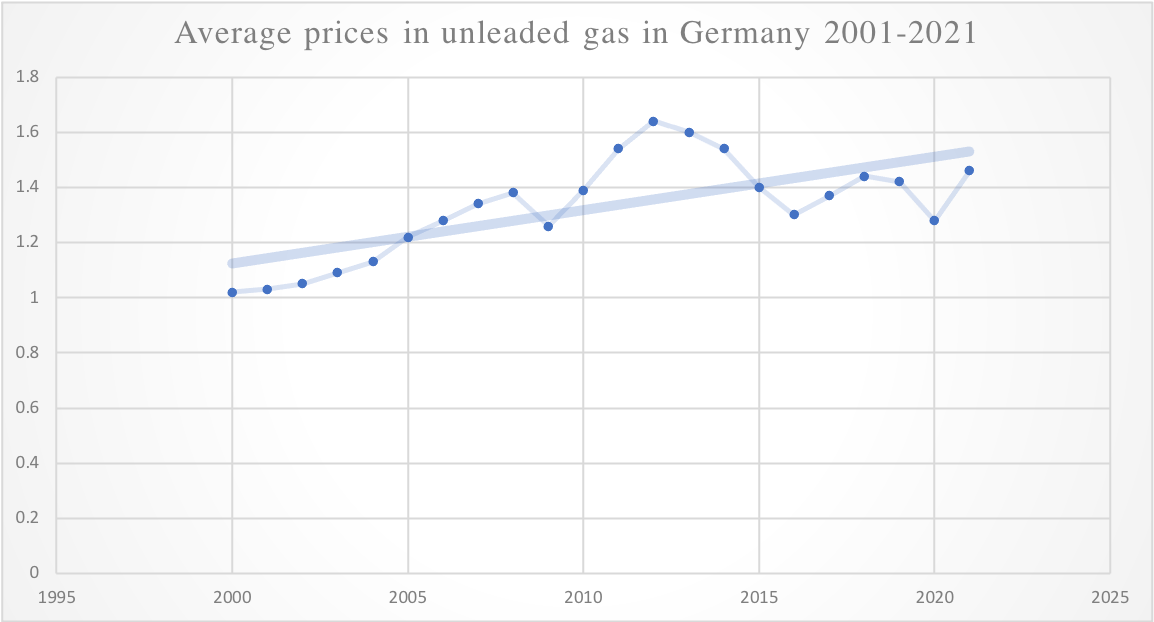
An inflation premium compensates investors for expected inflation and should cover the average inflation rate expected during debt maturity. As we may all be aware of the current events, the major central bank is increasing the interest rates to battle high inflation rates that erode money’s value and purchasing power. Assume an investor earns a real risk-free interest rate of 2% and an inflation premium of 4%. The sum of the interest earned (risk-free interest rate + inflation premium) 6% is the nominal risk-free interest rate. The inflation effect on purchasing power and the time value of money can be explained in autogas prices. Based on the data of unleaded auto gas prices between 2001 and 2021, €100 could buy 98 liters of gas, but in 2021 €100 could only buy 68 liters of gas. Thirty liters less gas compared to 2001 shows that purchasing power of money declined. If investments or savings are not protected against inflation and other risk factors, the value of money will be eroded.

 Bilgin Demir
Leave a comment